
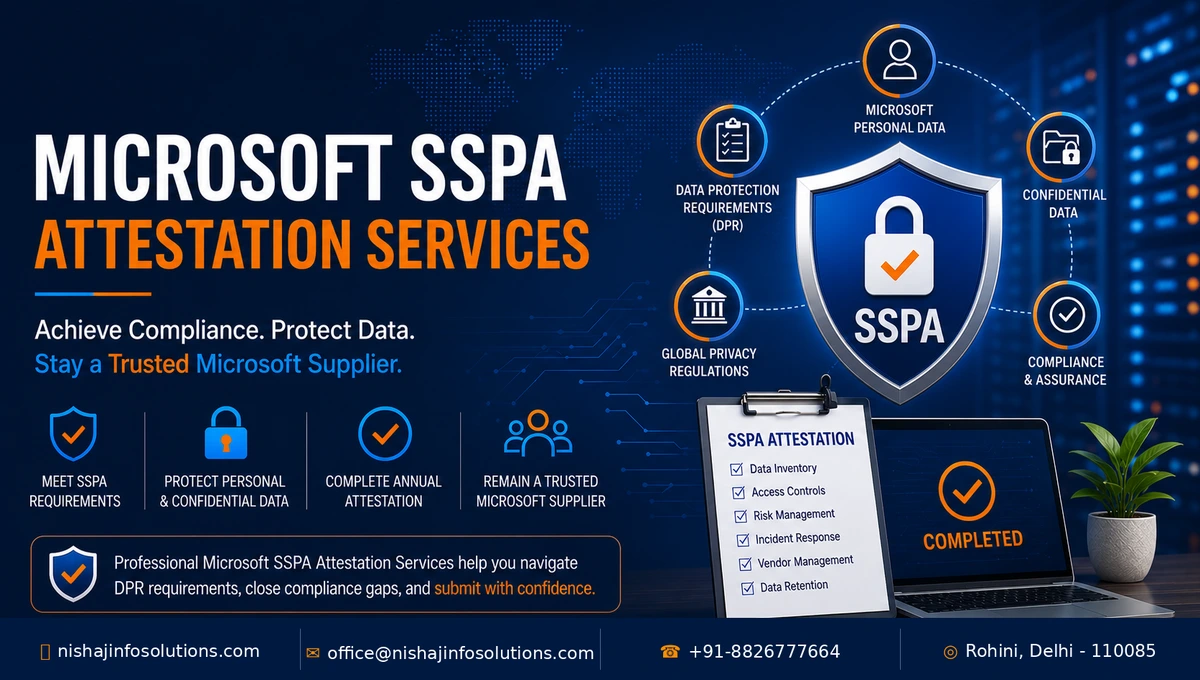
Microsoft’s Supplier Security and Privacy Assurance (SSPA) program mandates that all suppliers handling Microsoft Personal Data or Confidential Data complete an annual Data Protection Requirements (DPR) attestation. Organizations that fail to complete the Microsoft attestation service process risk suspension from Microsoft’s Supplier Portal — and loss of the engagement entirely. Professional Microsoft SSPA attestation services help suppliers navigate DPR requirements, close compliance gaps, and submit a defensible, audit-ready attestation on time.
1. What Is Microsoft SSPA and Why Was It Created? {#1-what-is-microsoft-sspa}
The Microsoft Supplier Security and Privacy Assurance (SSPA) program is Microsoft’s mandatory framework for governing how its global network of suppliers collects, stores, processes, and protects Microsoft Personal Data and Confidential Data. At the heart of this program is an annual attestation — commonly referred to as the Microsoft SSPA attestation — through which suppliers formally confirm their compliance with Microsoft’s Data Protection Requirements (DPR).
Microsoft launched and continues to evolve SSPA for a clear reason: as one of the world’s largest technology companies, Microsoft processes extraordinary volumes of personal and sensitive data on behalf of enterprises, governments, and individuals globally. Every third-party supplier who touches that data becomes a potential point of failure in Microsoft’s privacy and security posture.
The regulatory backdrop makes this urgency even sharper. With the enforcement of the EU General Data Protection Regulation (GDPR), the California Consumer Privacy Act (CCPA), and an expanding mosaic of national data protection laws — including India’s Digital Personal Data Protection Act (DPDPA) — Microsoft faces mounting legal accountability for how its supplier ecosystem handles personal data. SSPA is Microsoft’s mechanism for extending its own compliance obligations upstream into its supply chain.
The stakes are concrete:
- Non-compliant suppliers are flagged in Microsoft’s Supplier Portal and risk having purchase orders suspended or contracts terminated.
- For suppliers whose revenue is materially dependent on Microsoft engagements, an SSPA non-compliance event is not a minor administrative inconvenience — it is a business continuity risk.
- With increasing regulatory scrutiny on vendor management practices, an SSPA non-compliance finding can trigger questions from your own clients and auditors about how you manage third-party data obligations.
The Microsoft SSPA attestation service process is, in short, a non-negotiable annual requirement for any organization that wants to remain an active supplier to Microsoft.
2. Who Must Complete the Microsoft SSPA Attestation? {#2-who-must-complete}
If Microsoft has issued you a Supplier Data Protection Agreement (DPA) or your contract scope involves any of the following, you are required to complete the Microsoft SSPA attestation:
- Processing Microsoft Personal Data — any data relating to an identifiable individual that is collected or handled in the course of your Microsoft engagement
- Accessing Microsoft Confidential Data — proprietary or sensitive business information belonging to Microsoft
- Providing services that touch Microsoft’s IT systems or infrastructure
- Subprocessing data on behalf of Microsoft — even if you are a downstream processor rather than the primary supplier
Microsoft SSPA applies to suppliers across every sector and geography. Whether you are a professional services firm, a software vendor, a staffing agency, a logistics provider, or a facilities management company — if your scope of work with Microsoft involves personal or confidential data, the SSPA program applies to you.
Two core data categories determine your DPR scope:
| Data Category | Examples | DPR Applicability |
|---|---|---|
| Microsoft Personal Data (MPD) | Employee records, customer PII, contact data | Full DPR scope applies |
| Microsoft Confidential Data (MCD) | Proprietary code, financial data, business strategy | Subset of DPR applies |
The specific controls you must comply with — and whether Microsoft requires a self-attestation or an independent third-party assessment — depend on the volume and sensitivity of data you handle, as assessed during your annual DPR scoping exercise.
3. Understanding the Microsoft SSPA Data Protection Requirements (DPR) {#3-dpr-requirements}
The Data Protection Requirements (DPR) are the technical and organizational controls that form the substance of every Microsoft SSPA attestation. They are organized into requirement categories, and each requirement maps directly to globally recognized standards and regulations including GDPR, ISO 27001, NIST CSF, and SOC 2.
Understanding what the DPR actually demands — not just that it exists — is the foundation of a successful Microsoft SSPA attestation services engagement.
DPR Core Requirement Areas
1. Privacy Controls and Data Governance
Suppliers must demonstrate that personal data is collected, processed, and retained only for the purposes specified in the Microsoft DPA. Key controls include:
- Documented data inventory mapping every category of Microsoft personal data processed
- Data retention schedules with defined deletion or anonymization timelines
- Formal privacy impact assessment processes for new processing activities
- Clear ownership and accountability for privacy compliance within the organization
Key Takeaway: Privacy governance is not a legal team exercise — it requires active involvement from IT, operations, and senior management. During the Microsoft attestation service review, auditors look for evidence of operationalized privacy, not just documented policy.
2. Information Security Program
Suppliers must maintain a formal, documented information security program appropriate to the risk profile of the data they process. This includes:
- A written Information Security Policy reviewed and approved at a senior level
- Defined roles and responsibilities for information security governance
- Formal risk assessment and risk treatment processes conducted at least annually
- Security awareness training for all personnel with access to Microsoft data
Key Takeaway: Organizations that cannot produce a current, board-approved Information Security Policy with evidence of recent review are immediately flagged during the SSPA assessment process.
3. Access Control and Identity Management
Strict controls over who can access Microsoft data — and under what conditions — are among the most scrutinized DPR requirements:
- Role-based access control (RBAC) with the principle of least privilege enforced
- Multi-factor authentication (MFA) mandatory for all remote access to systems processing Microsoft data
- Privileged access management with documented approval workflows
- Regular access reviews and prompt de-provisioning upon contract or employment end
Key Takeaway: Unmanaged service accounts, orphaned credentials, and undocumented privileged access are three of the most common findings during Microsoft SSPA assessments. Fixing these before attestation is far less costly than explaining them after.
4. Incident Detection, Response, and Notification
Microsoft’s DPR requires suppliers to maintain an active capability to detect, investigate, and report data security incidents:
- A documented Incident Response Plan (IRP) with defined roles and escalation paths
- Security monitoring and alerting capabilities appropriate to the environment’s risk level
- A tested process for notifying Microsoft of any confirmed or suspected personal data breach — the DPR specifies notification timelines that align with GDPR’s 72-hour requirement
- Post-incident review and root cause analysis documentation
Key Takeaway: The notification obligation is often the most overlooked DPR requirement. Many suppliers have informal incident processes that were never designed around external notification timelines. Discovering this gap during an actual incident is catastrophically worse than fixing it during compliance preparation.
5. Vulnerability Management and Secure Configuration
- Formal vulnerability scanning on systems processing Microsoft data, conducted at defined intervals
- A documented process for prioritizing and remediating vulnerabilities by severity
- Secure baseline configurations for servers, endpoints, and cloud services
- Patch management processes with defined SLAs for critical patches
6. Third-Party and Subprocessor Management
If you engage subcontractors who in turn access Microsoft data, the DPR requires you to flow down equivalent protections:
- Formal security and privacy assessments of subprocessors before onboarding
- Contractual obligations in subprocessor agreements that mirror your own DPA obligations to Microsoft
- Ongoing monitoring of subprocessor compliance, not just point-in-time onboarding assessment
Key Takeaway: Many SSPA findings originate not from the primary supplier’s systems, but from gaps in subprocessor oversight. Microsoft’s supply chain accountability expectations extend to your extended supply chain.
7. Physical Security Controls
For suppliers who process Microsoft data in physical facilities:
- Controlled physical access to data processing areas with documented access logs
- Clear desk and clean screen policies in areas where Microsoft data is handled
- Secure disposal of physical media containing Microsoft data
8. Data Transfer and Cross-Border Controls
Given Microsoft’s global supplier base, cross-border data transfers are common — and strictly governed:
- Transfer mechanism documentation (Standard Contractual Clauses, adequacy decisions, Binding Corporate Rules)
- Data residency awareness — knowing where Microsoft data is physically stored and processed
- Encryption requirements for data in transit across borders
4. What Does the Microsoft Attestation Service Process Actually Involve? {#4-attestation-process}
The Microsoft attestation service process follows an annual cycle, anchored to Microsoft’s Supplier Portal. Here is how it works in practice — step by step.
Step 1: Supplier Portal Notification and Scoping
Each year, Microsoft sends an SSPA attestation notification through the Supplier Portal. The notification triggers a scoping questionnaire that determines which DPR requirements apply to your specific engagement. Your answers to the scoping questions determine whether you need a self-attestation or an independent assessment (covered in Section 7).
Step 2: DPR Gap Assessment
Before you can attest to compliance, you need to know where you actually stand. A gap assessment maps your current controls against every applicable DPR requirement — identifying what is fully in place, what is partially implemented, and what is entirely absent.
Step 3: Remediation
Gaps identified in the assessment must be addressed before attestation. Depending on the nature of the gap, remediation could involve:
- Drafting or updating documented policies
- Implementing or reconfiguring technical controls
- Running security awareness training
- Establishing new governance processes
- Formalizing third-party contracts
Step 4: Evidence Collection and Documentation
Attestation is not a declaration of intent — it is a claim of compliance backed by evidence. Before submitting, suppliers must have organized documentation for every DPR control, including policies, training records, access review logs, vulnerability scan reports, and incident response plans.
Step 5: Attestation Submission via Microsoft Supplier Portal
With gaps remediated and evidence organized, the formal attestation is submitted through the Microsoft Supplier Portal. For self-attestation, the organization’s authorized representative signs off. For independent assessments, the accredited assessor’s findings are submitted alongside the attestation.
Step 6: Microsoft Review and Continuous Monitoring
Microsoft reviews submissions and may follow up with clarifying questions or additional evidence requests. Importantly, SSPA compliance is not simply a filing exercise — suppliers are expected to maintain their controls throughout the year, not just at attestation time.
5. Where Suppliers Go Wrong: Common SSPA Compliance Failures {#5-common-failures}
Understanding common failure patterns is as important as knowing what good compliance looks like.
Failure 1: Starting Too Late
The SSPA attestation window is not infinite. Suppliers who wait until the last few weeks to begin their gap assessment frequently discover that remediating identified gaps — particularly those requiring policy development, system configuration, or third-party contract amendments — cannot be completed before the submission deadline.
Failure 2: Treating Attestation as a Documentation Exercise
Some suppliers focus entirely on producing the right documents without ensuring that those documents reflect operational reality. Microsoft’s independent assessment requirement (applicable to higher-risk engagements) exists precisely because self-declarations can be unreliable. Attesting to controls that are not genuinely operational is both a compliance risk and, in some cases, a contractual liability.
Failure 3: Ignoring the Subprocessor Requirement
Suppliers who use third-party services — cloud providers, SaaS platforms, contractors — to process Microsoft data often fail to include those relationships in scope. The DPR’s subprocessor management requirements are not optional for engagements that involve downstream data processing.
Failure 4: Treating SSPA as a One-Time Annual Event
SSPA compliance requires year-round maintenance. Access reviews, patch management, security monitoring, incident response testing, training refreshes — these are continuous obligations, not annual activities. Organizations that only think about SSPA during attestation season are, by definition, not continuously compliant.
Failure 5: Inadequate Incident Response Processes
The DPR’s breach notification requirements often expose the absence of a functioning incident response capability. Many suppliers have an IRP document that has never been tested and does not include the specific timelines, escalation paths, and contact details required for Microsoft notification.
6. What Do Professional Microsoft SSPA Attestation Services Cover? {#6-what-services-cover}
Professional Microsoft SSPA attestation services are designed to take suppliers from wherever they currently stand to a submitted, defensible attestation — and to keep them there across subsequent annual cycles.
Gap Assessment Against Full DPR Scope
The starting point is always an honest, thorough evaluation of current compliance posture against every applicable DPR requirement. This produces a prioritized remediation roadmap, not just a list of findings.
What this covers:
- Review of existing policies, procedures, and technical control documentation
- Interviews with key personnel across IT, legal, and operations
- Evidence sampling to confirm that documented controls are operationally active
- Mapping of all Microsoft personal data flows across your organization and subprocessors
Policy and Documentation Development
For organizations with gaps in their governance documentation, SSPA service providers develop the specific policies and procedures required by the DPR:
- Information Security Policy
- Privacy Policy and Data Processing Register
- Incident Response Plan with Microsoft-specific notification provisions
- Access Control Policy and Privileged Access Management procedures
- Vendor and Subprocessor Management Policy
- Data Retention and Deletion Schedule
Technical Control Remediation Support
Beyond documentation, many DPR requirements demand specific technical controls. SSPA service providers support the implementation and configuration of:
- Multi-factor authentication deployment across relevant systems
- Vulnerability scanning tools and remediation workflow establishment
- Log management and security monitoring aligned with DPR detection requirements
- Data Loss Prevention (DLP) configurations for endpoints handling Microsoft data
- Encryption controls for data at rest and in transit
Evidence Organization and Attestation Preparation
Before submitting the attestation, all required evidence must be organized, reviewed for accuracy, and mapped to the specific DPR control it supports. Professional service providers structure this evidence package so that every attestation claim is directly supported by retrievable documentation.
Independent Assessment Coordination
For suppliers required to undergo an independent assessment rather than self-attestation, service providers either conduct the assessment directly (where accredited) or coordinate with a qualified assessor — managing the process so that the supplier can focus on remediation rather than logistics.
Post-Attestation Continuous Compliance Support
The strongest SSPA service engagements do not end at submission. Ongoing support covers:
- Quarterly access reviews and evidence refresh
- Annual DPR update monitoring — Microsoft periodically revises its requirements, and suppliers must track and respond to those changes
- Year-round compliance advisory for changes in your operating environment (new systems, new subprocessors, new data processing activities)
7. Independent Assessments: When Microsoft Requires Third-Party Validation {#7-independent-assessments}
Not all suppliers can complete the Microsoft SSPA attestation through self-declaration. Microsoft’s SSPA program uses a tiered approach based on data sensitivity and processing volume — and for higher-risk engagements, an Independent Assessment (IA) by an accredited third-party assessor is mandatory.
Independent Assessments are typically required when a supplier:
- Processes large volumes of Microsoft Personal Data
- Handles sensitive categories of personal data (financial, health, identity)
- Has previously received compliance findings or flags in the Supplier Portal
- Operates in high-risk jurisdictions from a data protection perspective
What an Independent Assessment involves:
The assessor conducts a structured evaluation of the supplier’s DPR compliance through documentation review, personnel interviews, and technical evidence examination. The assessment results in a formal report submitted to Microsoft as part of the attestation package.
Key Takeaway: Suppliers who discover they require an independent assessment late in the attestation cycle often cannot meet the submission deadline. Understanding your assessment tier at the start of the annual cycle is essential for planning.
What to look for in an independent assessor:
- Formal accreditation or recognition within the Microsoft SSPA ecosystem
- Experience with technology and data processing environments similar to yours
- Demonstrated expertise in both privacy regulations (GDPR, CCPA, DPDPA) and technical security controls
- A track record of findings reports that are clear, evidence-based, and actionable
8. Key Takeaways at a Glance {#8-key-takeaways}
- Microsoft SSPA is mandatory for all suppliers who handle Microsoft Personal Data or Confidential Data under a Supplier Data Protection Agreement
- Annual attestation through the Microsoft Supplier Portal is required — non-compliance risks suspension of purchase orders and contract termination
- The DPR covers eight core areas: privacy governance, information security, access control, incident response, vulnerability management, third-party oversight, physical security, and data transfer controls
- Self-attestation vs. independent assessment depends on your data processing profile — knowing your tier at the start of the cycle is critical for timeline planning
- Common failure modes include late starts, treating attestation as documentation-only, ignoring subprocessors, and maintaining an untested IRP
- Professional Microsoft SSPA attestation services cover gap assessment, remediation, documentation, evidence organization, independent assessment coordination, and ongoing compliance support
- SSPA is a continuous obligation — year-round maintenance of controls, not just annual attestation activity, is what genuine compliance requires
- Subprocessor management is a frequently overlooked but heavily scrutinized area — your downstream data processing chain is in scope
9. How to Choose the Right Microsoft SSPA Compliance Partner {#9-choose-partner}
Selecting the right partner for your Microsoft SSPA attestation services engagement is a decision with direct consequences for compliance outcomes — and for the relationship with Microsoft itself.
Specific Microsoft SSPA Program Knowledge
Generic GRC consultants who are unfamiliar with Microsoft’s Supplier Portal, DPR structure, or annual attestation process will cost you time you do not have. Look for partners who have worked with multiple Microsoft suppliers across different DPR tiers and can demonstrate current knowledge of the program.
Privacy and Security Integration
The DPR spans both privacy law (GDPR, CCPA, DPDPA compliance) and technical security controls (vulnerability management, access control, incident response). Effective SSPA support requires a team that is fluent in both — not a privacy firm that defers on technical controls, or a security firm that defers on regulatory requirements.
Independent Assessment Capability
If your engagement profile requires an independent assessment, your service provider should either be accredited to conduct it or have established relationships with qualified assessors. Discovering this gap after you have already engaged a partner can leave you scrambling at a critical point.
Evidence-First Methodology
A strong SSPA partner builds your compliance program around evidence — not just policy documents. Every control should be demonstrable, every claim retrievable. This matters not only for the current attestation but for future audits by Microsoft, your own clients, or regulatory bodies.
Post-Attestation Continuity
The best SSPA engagements do not end on submission day. Choose a partner who offers structured support for maintaining compliance across the full annual cycle — tracking DPR updates, managing quarterly evidence refresh, and advising on changes to your data processing environment.
Transparency About Gaps
Your SSPA compliance partner should surface uncomfortable findings early. An engagement that only confirms what you want to hear is not compliance support — it is a liability.
10. Final Thoughts {#10-final-thoughts}
The Microsoft SSPA attestation is not a bureaucratic inconvenience to be cleared once a year and forgotten. It is Microsoft’s formal mechanism for holding its global supplier network accountable for the privacy and security of data that ultimately belongs to individuals — employees, customers, citizens — who have the right to expect it is handled responsibly.
Suppliers who approach Microsoft SSPA attestation services strategically — investing in genuine control implementation rather than surface-level documentation — do not just satisfy a contractual requirement. They build security and privacy capabilities that strengthen their entire organization: making them more trustworthy to every client, more resilient to cyber threats, and better positioned in a regulatory environment that is only becoming more demanding.
The time to prepare is not when the Supplier Portal notification arrives. It is now — with an honest gap assessment, a clear remediation roadmap, and the expertise to execute it.
Ready to begin your Microsoft SSPA attestation? Connect with the Nishaj InfoSolutions team for an expert-led gap assessment and end-to-end attestation support.