
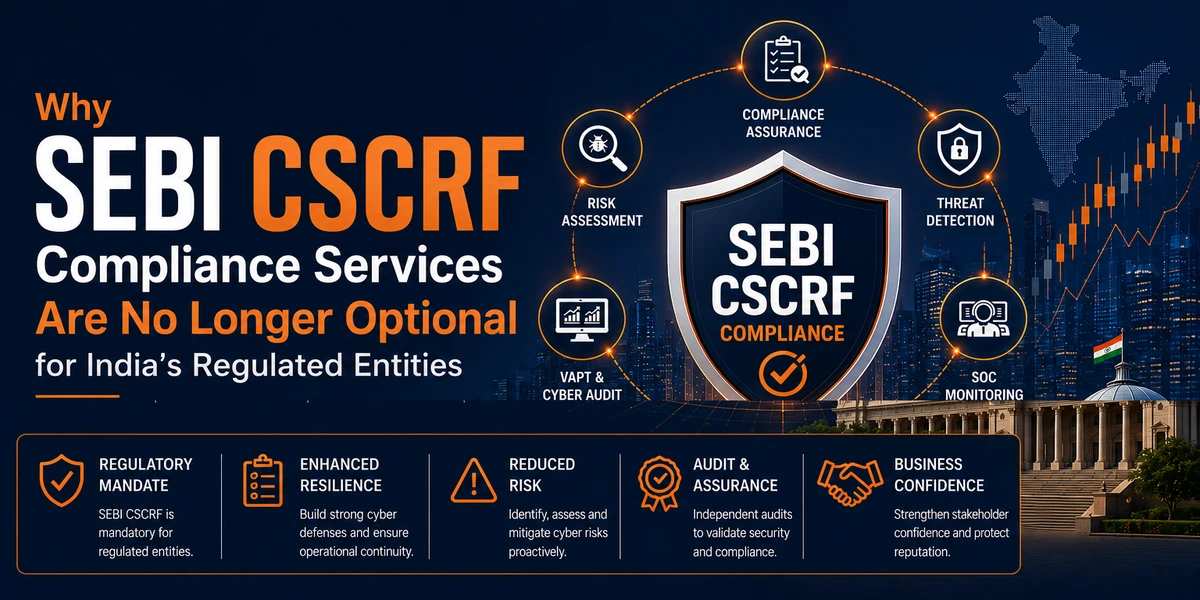
India’s securities market is under siege — not from market volatility, but from cyber threats that are growing faster than most organizations can respond to. Regulated entities registered with SEBI — brokers, depositories, AMCs, exchanges — sit at the heart of this risk. They hold sensitive investor data, process billions in daily transactions, and are increasingly targeted by sophisticated threat actors who know exactly how valuable that data is.
SEBI recognized this and introduced the Cybersecurity and Cyber Resilience Framework (CSCRF) — a structured, mandatory directive that raises the bar for how every regulated entity protects itself. Yet across the industry, many organizations are still treating SEBI CSCRF Compliance services as a periodic formality rather than the ongoing operational priority it was designed to be.
This blog cuts through the noise. It explains what SEBI CSCRF actually demands, why organizations struggle to meet those demands, and what a proper compliance engagement — including a SEBI CSCRF System Audit and SEBI CSCRF Cyber Audit — looks like in practice.
TL;DR: SEBI CSCRF is mandatory for all SEBI-regulated entities. It requires continuous compliance, formal system and cyber audits by CERT-In empanelled auditors, and documented controls across governance, technology, and people. Organizations that treat it as a checkbox risk penalties, reputational damage, and regulatory action. Professional SEBI CSCRF Compliance services help you build and sustain a compliant, resilient cybersecurity posture.
1. What Is SEBI CSCRF and Why Does It Exist?
SEBI’s Cybersecurity and Cyber Resilience Framework (CSCRF) is a comprehensive mandatory directive issued by the Securities and Exchange Board of India. It requires all regulated entities (REs) in the securities market to establish, maintain, and continuously improve their cybersecurity posture. Built on globally recognized frameworks including NIST CSF, ISO 27001, and COBIT, CSCRF is adapted specifically for the structure and risk profile of India’s financial markets.
The numbers behind why SEBI acted tell a sobering story:
India’s Cyber Threat Landscape — The Hard Data
India’s financial sector faced 135,173 phishing attacks in just the first half of 2024 alone — a rise of 175% over the same period the previous year, driven by AI-powered phishing campaigns and expanded digital adoption (Kaspersky via Business Standard, November 2024).
In 2024, India recorded nearly 22.68 lakh cybercrime incidents, with financial losses jumping 206% year-on-year to ₹22,845 crore — and 2025 saw that case count climb further to 28.15 lakh reported incidents (Ministry of Home Affairs data, The Print, February 2026).
Cyberattacks on banks and financial firms more than doubled in 2024, and 2025 saw over 248 confirmed data breaches across scheduled commercial banks, with a 15% surge in attacks targeting the financial sector specifically (Tripwire, 2025; Cyber Law Consulting, 2025).
The average cost of a data breach in India reached USD 2.35 million in 2024, up 7.8% year-on-year (IBM Cost of a Data Breach Report 2024, via Fintech Singapore).
CSCRF is SEBI’s direct response to this threat environment. Its five core pillars — Identify, Protect, Detect, Respond, and Recover — create a framework for building lasting cyber resilience, not just reactive security.
Key CSCRF objectives include:
- Identifying and classifying critical cyber assets and their risk levels
- Protecting systems and data through preventive technical and governance controls
- Detecting threats in real time through continuous monitoring and alerting
- Responding to cyber incidents with documented, tested response plans
- Recovering operations quickly with minimal disruption and measurable RTO/RPO targets
2. Who Needs SEBI CSCRF Compliance?
If you are registered with SEBI and operate within India’s securities market, CSCRF applies to you. The framework uses a tiered classification model based on systemic importance, transaction volumes, and organizational size — so compliance requirements scale with your risk profile, but they do not disappear for smaller entities.
Regulated entities covered under SEBI CSCRF include:
- Stock Brokers and Sub-Brokers
- Depository Participants (DPs)
- Stock Exchanges and Clearing Corporations
- Asset Management Companies (AMCs)
- Portfolio Managers and Investment Advisers
- KYC Registration Agencies (KRAs)
- Research Analysts and Proxy Advisers
- Mutual Fund Distributors (where applicable)
Whether you are a Tier-1 exchange handling crores of transactions daily or a smaller registered intermediary, non-compliance is not a viable option. The consequences include regulatory penalties, suspension of registration, and the kind of reputational damage that takes years to rebuild.
3. Why Do Organizations Struggle with CSCRF?
This is the honest conversation that most compliance guides avoid. The gap between what SEBI CSCRF requires and what most organizations actually have in place is significant — and it exists for predictable reasons.
Trap 1: “We have an IT team, so we are covered.”
Having an IT team is not the same as having a cybersecurity compliance program. CSCRF demands documented policies, formal risk registers, vendor management frameworks, board-level governance structures, and audit trails. These go far beyond what routine IT operations produce.
Trap 2: “We did a one-time audit last year.”
CSCRF is a continuous compliance framework. It requires periodic SEBI CSCRF System Audits, ongoing vulnerability assessments, real-time monitoring, and regular policy reviews. A one-time audit gives you a snapshot — not a safety net.
Trap 3: “We are too small to be targeted.”
Threat actors do not always go after the biggest targets. Smaller intermediaries with weaker controls frequently become entry points into larger ecosystems. SEBI’s tiered framework covers smaller entities precisely because of this systemic risk.
The result of these misconceptions? Gaps in governance, undocumented processes, unreviewed vendor access, unpatched vulnerabilities, and untested incident response plans — all of which surface painfully during a SEBI CSCRF Cyber Audit.
4. What Do SEBI CSCRF Compliance Services Actually Cover?
Professional SEBI CSCRF Compliance services are not about filling out a regulatory form and filing it. They are about transforming your organization’s cybersecurity posture from reactive and ad-hoc to structured and resilient. Here is what a comprehensive CSCRF compliance engagement looks like in practice.
Gap Assessment and Readiness Review
Before anything else, a compliance partner will evaluate where you currently stand against CSCRF requirements. This honest baseline assessment becomes the foundation of your entire compliance roadmap.
What this covers:
- Review of existing cybersecurity policies and documented procedures
- Assessment of current technical controls against CSCRF mandates
- Identification of missing documentation and unaddressed requirements
- Mapping of existing controls to the five CSCRF pillars
Key Takeaway: Organizations that skip the gap assessment often discover critical non-conformities during a formal SEBI CSCRF System Audit — exactly the worst possible moment. A readiness review gives you time to fix gaps on your own terms.
Policy and Framework Development
Most organizations have informal security practices. CSCRF demands formalization. Compliance service providers help you build, document, and operationalize:
- Information Security Policy aligned with CSCRF requirements
- Cyber Crisis Management Plan (CCMP)
- Incident Response Plan (IRP) with defined roles and escalation paths
- Business Continuity and Disaster Recovery Plan (BCP and DRP)
- Vendor and Third-Party Risk Management Policy
Key Takeaway: During a SEBI CSCRF System Audit, auditors look for evidence that controls are not just claimed but actively practiced. Documentation is proof of control, not bureaucracy.
Cyber Risk Assessment and Treatment
CSCRF requires regulated entities to conduct formal, documented cyber risk assessments on a periodic basis. This involves:
- Identifying and classifying critical information assets and systems
- Evaluating threats and vulnerabilities specific to your operating environment
- Assessing the likelihood and business impact of cyber incidents
- Developing a risk treatment plan with clear ownership and timelines
Key Takeaway: Risk assessments must be living documents. Static assessments completed once and filed away quickly become irrelevant as your IT environment and threat landscape evolve.
Technical Control Implementation
Compliance is not just paperwork. SEBI CSCRF mandates specific technical controls that compliance service providers help you configure, deploy, and validate:
- Multi-factor authentication (MFA) across critical systems and privileged accounts
- Data Loss Prevention (DLP) solutions for sensitive investor and trading data
- Privileged Access Management (PAM) with periodic access reviews
- Security Information and Event Management (SIEM) for centralized log aggregation
- Endpoint Detection and Response (EDR) across organizational devices
- Network segmentation and periodic firewall rule reviews
Key Takeaway: Technical controls must be calibrated to your tier classification under CSCRF. The right controls for a Tier-1 entity differ from those required for a Tier-3 entity — and getting that calibration wrong creates either excessive cost or compliance risk.
Continuous Monitoring and Reporting
CSCRF is not a set-and-forget framework. Compliance services include establishing mechanisms for:
- Real-time threat detection and alerting
- Log management and retention aligned with SEBI-mandated timelines
- Periodic vulnerability assessments and penetration testing cycles
- Regular compliance status reporting to senior management and the board
Key Takeaway: Regulators expect evidence of continuous compliance, not point-in-time snapshots. Organizations with mature monitoring programs are far better positioned during regulatory inspections and formal audits.
5. What Is a SEBI CSCRF System Audit?
The SEBI CSCRF System Audit is a formal, structured audit of your IT infrastructure and cybersecurity systems, conducted by CERT-In empanelled auditors as per SEBI’s prescribed requirements. Think of it as a comprehensive technical health check — not just confirming that security tools are installed, but verifying they are configured correctly, functioning as intended, and aligned with CSCRF mandates.
What a SEBI CSCRF System Audit examines:
Network Architecture Review — Is your network properly segmented? Are DMZ configurations adequate? Are firewall rules periodically reviewed and tightened?
Access Control Audit — Who has access to which systems? Are privileged accounts managed and monitored? Are access reviews conducted at defined intervals?
Patch Management Assessment — Are systems kept updated? How are critical vulnerabilities prioritized, tracked, and closed?
Data Security Controls — Is sensitive investor and trading data encrypted both in transit and at rest? Are backup processes tested and recovery verified?
Application Security — Are web-facing applications tested for OWASP Top 10 vulnerabilities? Is secure development embedded in your SDLC?
Incident Response Readiness — Is your IRP documented, assigned, and tested through tabletop or simulation exercises?
Log Management — Are audit logs enabled across critical systems, centralized, and retained for the duration SEBI mandates?
Key Takeaways from the System Audit:
- System audits must be conducted by CERT-In empanelled auditors — auditor selection is itself a compliance requirement
- Findings are categorized by severity, and critical findings require remediation within defined timelines
- Audit reports must be submitted to SEBI within prescribed deadlines
- Repeat non-conformities from previous audits signal a weak compliance culture to regulators
The system audit is not an adversarial exercise. Organizations that approach it with preparation and transparency use it as a genuine improvement tool rather than a regulatory hurdle.
6. What Is a SEBI CSCRF Cyber Audit?
While the system audit focuses on technical infrastructure, the SEBI CSCRF Cyber Audit evaluates your organization’s entire cybersecurity governance posture — covering people, processes, and technology together.
If the system audit asks “Are your systems secure?”, the cyber audit asks “Is your organization truly cyber resilient?”
Core areas covered in a SEBI CSCRF Cyber Audit:
Governance and Leadership Assessment
- Is cybersecurity formally on the board agenda?
- Is there a designated CISO or equivalent accountability structure?
- Is a Cyber Security Committee in place as mandated by CSCRF?
- Are cybersecurity budgets proportional to the organization’s risk exposure?
Third-Party and Supply Chain Risk
- How are vendors assessed and approved before onboarding?
- Are security requirements formally documented in vendor contracts and SLAs?
- Is there a structured process for revoking vendor access when engagements end?
Security Awareness and Culture
- Are employees trained on phishing, social engineering, and secure data handling?
- Are training records maintained and refreshed at defined intervals?
- Is there a culture where staff feel safe reporting suspicious activity?
Cyber Crisis Simulation and Tabletop Exercises
- Has the incident response plan been tested through realistic simulated scenarios?
- Are lessons from past incidents or near-misses formally documented and applied?
Maturity Assessment Against All Five CSCRF Pillars
The cyber audit maps your organization’s maturity across Identify, Protect, Detect, Respond, and Recover — producing a maturity score and a prioritized improvement roadmap that drives the next compliance cycle.
Key Takeaway: The cyber audit surfaces the gap between documented policy and operational reality. Many organizations discover that policies exist on paper but are not practiced on the ground. The cyber audit finds this before a regulator does.
7. Key Takeaways at a Glance
- SEBI CSCRF is mandatory for all SEBI-regulated entities regardless of size or tier classification
- Compliance is continuous — not a one-time audit exercise
- SEBI CSCRF Compliance services span gap assessment, policy development, risk management, technical controls, and ongoing monitoring
- SEBI CSCRF System Audit is a deep technical review of networks, access, applications, patch management, logs, and incident readiness
- SEBI CSCRF Cyber Audit evaluates governance, leadership accountability, third-party risk, security culture, and organizational resilience
- Auditors must be CERT-In empanelled — this is a regulatory requirement, not a preference
- Non-compliance carries real consequences including financial penalties, reputational damage, and potential suspension of registration
- Organizations that prepare early face far fewer surprises during regulatory reviews and audit submissions
8. How to Choose the Right SEBI CSCRF Compliance Partner
Choosing the right compliance partner is as important as compliance itself. Here is what to evaluate:
Experience in SEBI-regulated environments — Your compliance partner should have deep familiarity with the securities market ecosystem, not just generic cybersecurity expertise. The nuances of broker operations, depository systems, and trading infrastructure are specific and material.
CERT-In empanelment — For system audits, the auditing firm must be empanelled with CERT-In. Always verify this before signing an engagement.
End-to-end capability — Look for partners who support you through gap assessment, policy development, technical implementation, audit preparation, and post-audit remediation — not just one phase of the journey.
Proven track record with SEBI-regulated entities — Ask for references from similar organizations. A partner who has helped comparable intermediaries navigate CSCRF audits successfully is a strong indicator of genuine competence.
Transparency over reassurance — Compliance journeys surface uncomfortable truths. You want a partner who will tell you what you need to hear, not what you want to hear.
9. Final Thoughts
Cybersecurity compliance in India’s securities markets has moved well beyond optional. SEBI CSCRF has raised the bar — deliberately and for good reason. The interconnected nature of financial markets means one organization’s weak controls can become a systemic risk affecting thousands of investors and market participants.
SEBI CSCRF Compliance services, approached strategically rather than reactively, do more than keep regulators satisfied. They build organizations that are genuinely stronger, more resilient, and more trustworthy in the eyes of clients, counterparties, and the market at large.
Whether you are beginning your CSCRF journey, preparing for a SEBI CSCRF System Audit, or strengthening your posture ahead of a SEBI CSCRF Cyber Audit, the right time to act is now — not after a SEBI notice arrives.
Start with an honest gap assessment. Build from there with the right expertise. Because in cybersecurity, organizations that prepare do not just survive regulatory scrutiny — they set the standard for their peers.
Have questions about SEBI CSCRF Compliance for your organization? Connect with the Nishaj InfoSolutions team and take the first step toward genuine cyber resilience.