
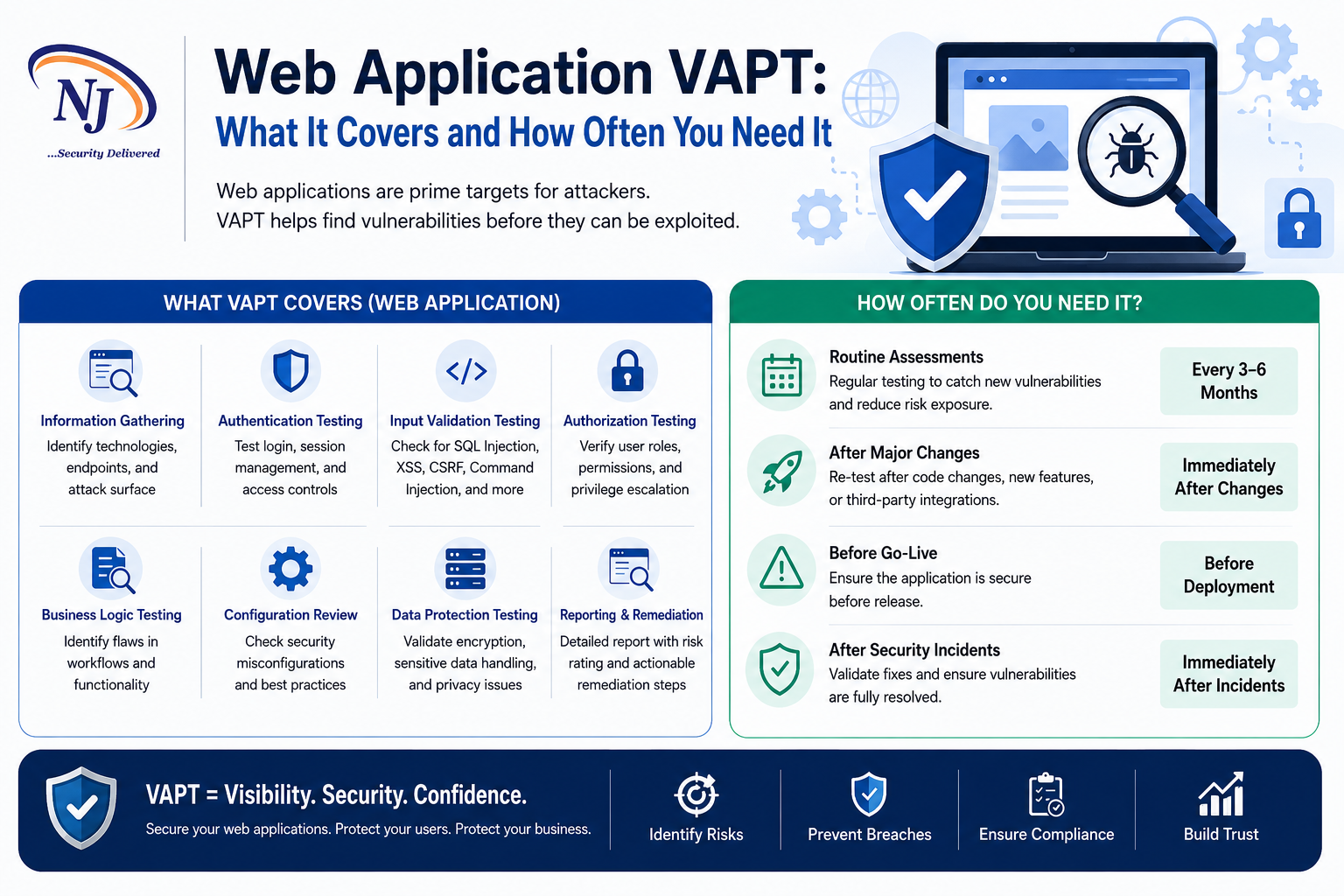
Your website might be the first thing a customer sees, but it’s also the first thing an attacker probes. Login forms, payment gateways, file uploads, search bars, and APIs all sit on the open internet, reachable by anyone, at any hour. A single overlooked flaw in any one of them can expose customer data, drain accounts, or hand an attacker a foothold into your entire network.
We’ve run web application VAPT engagements for clients who were confident their site was clean, simply because it had “never had a problem.” Confidence isn’t evidence. In our experience, most applications that haven’t been formally tested in over a year turn up at least one medium-or-higher severity finding, often in a feature nobody thought to question because it had been working fine for years.
This guide walks through what web application VAPT actually covers, how it’s carried out, and — the question we get asked most often by clients — how frequently you genuinely need it.
What is Web Application VAPT?
Web Application VAPT (Vulnerability Assessment and Penetration Testing) is a focused security exercise that examines your website, web portal, or web-based application for exploitable weaknesses. It combines two complementary techniques:
Vulnerability Assessment (VA): Automated and manual scanning of your application to identify known flaws, misconfigurations, and weak points across its code, server setup, and third-party components.
Penetration Testing (PT): Certified ethical hackers actively attempt to exploit those flaws, the way a real attacker would, to confirm whether a vulnerability is genuinely dangerous or just theoretical.
Unlike a generic network scan, web application VAPT is built around how web apps actually behave: how they handle user input, manage sessions, authenticate users, and talk to back-end databases and APIs. According to NIST SP 800-115, the technical guide most penetration testing methodologies in the US and India are built on, this kind of targeted, application-aware testing consistently surfaces risks that generic infrastructure scans miss entirely.
Why Web Applications Are a Prime Target
Web applications are attractive targets for a simple reason: they’re always reachable, and they usually sit closest to your most valuable data. A flaw in your login page or checkout flow doesn’t just affect that one feature — it can expose your customer database, payment information, or internal systems sitting behind it.
Most breaches involving web applications trace back to a small, recurring set of issues: unvalidated user input, weak authentication, outdated libraries, and misconfigured servers. None of these require a sophisticated attacker. They require an unpatched application and enough time, and on the open internet, time is the one thing attackers have plenty of.
What Web Application VAPT Covers
A thorough web application VAPT engagement looks across the entire application, not just the obvious entry points. Here’s what’s typically in scope:
OWASP Top 10 Vulnerabilities
The OWASP Top 10 is the industry-recognized baseline for web application risk, maintained by the Open Worldwide Application Security Project. Our testing covers it in full, including:
Broken Access Control — can a regular user view or modify another user’s data simply by changing a URL or parameter?
Injection flaws — SQL injection, command injection, and similar attacks where unvalidated input reaches a backend system
Cryptographic failures — sensitive data transmitted or stored without proper encryption
Security misconfiguration — default credentials, verbose error messages, exposed admin panels
Cross-Site Scripting (XSS) — attacker-controlled scripts running in another user’s browser
Vulnerable and outdated components — libraries, plugins, or frameworks with known CVEs
Identification and authentication failures — weak password policies, broken session management, missing multi-factor authentication
Server-Side Request Forgery (SSRF) and other emerging risk categories
Authentication and Session Management
We test login flows, password reset mechanisms, session timeout behavior, and token handling to confirm an attacker can’t hijack, guess, or bypass a legitimate user’s session.
Business Logic Flaws
Automated scanners are good at finding technical bugs, but they routinely miss logic flaws specific to how your application actually works — manipulating a price field during checkout, replaying a discount code beyond its intended limit, or skipping a verification step by calling an API endpoint directly instead of going through the UI. This is where manual testing by an experienced human tester earns its value; a scanner doesn’t know your business rules, but a tester who’s read your spec does.
File Upload and Input Handling
Any feature that accepts files or free-text input — profile pictures, document uploads, comment boxes, search fields — is tested for malicious file uploads, injection attacks, and improper sanitization.
API Endpoints Behind the Application
Most modern web apps run on REST or GraphQL APIs behind the scenes. We test these endpoints directly for broken object-level authorization, excessive data exposure, and rate-limiting gaps, not just the visible front end a user actually sees.
Server and Configuration Review
Beyond the application code itself, we review the underlying web server, SSL/TLS configuration, HTTP security headers, and exposed directories or files that shouldn’t be publicly accessible.
Black Box, Grey Box, and White Box Testing: Which One Do You Need?
Not every engagement needs the same level of access. We scope this with you up front, based on what you’re trying to learn:
ApproachTester AccessBest ForBlack BoxNo prior knowledge or credentialsSimulating an outside attacker with zero insider informationGrey BoxLimited access, such as a standard user accountMost real-world engagements; balances realism with depthWhite BoxFull access, including source codeDeepest possible coverage, often paired with source code review
Most of our clients get the best value from grey box testing. It mirrors what a registered user — or a compromised user account — could actually do, while still letting testers dig deeper than a complete outsider could. Pure black box testing looks more “realistic” on paper, but it often burns scoped hours on reconnaissance an attacker has unlimited time for and you don’t.
Our Web Application VAPT Methodology
We follow a structured approach aligned with the OWASP Testing Guide, PTES (Penetration Testing Execution Standard), and NIST SP 800-115:
Scoping: Confirm which domains, subdomains, and environments (staging or production) are in scope, along with any compliance requirements driving the engagement.
Reconnaissance: Map the application’s structure, technology stack, exposed subdomains, and publicly available information.
Automated and Manual Vulnerability Identification: Combine tools like Burp Suite, OWASP ZAP, and Nikto with hands-on manual testing to find what automation alone misses.
Exploitation: With your authorization, attempt to exploit confirmed vulnerabilities to demonstrate real-world impact, not just theoretical risk.
Reporting: Deliver findings with severity ratings, proof-of-concept evidence, business impact, and clear remediation steps, plus a separate executive summary for leadership.
Remediation Support and Re-Testing: Help your developers understand and fix issues, then re-test to confirm the fixes actually hold.
A Pattern We See Often
One thing worth flagging from our own engagements, without naming any client: a surprising number of “secure” applications fail not on some exotic zero-day, but on broken access control — a regular user account that can view another user’s invoice, order, or profile just by changing an ID number in the URL. It’s not glamorous, it doesn’t require advanced tooling, and it’s exactly the kind of thing a quick automated scan often misses because nothing about the request looks “malicious” on the surface. It takes a tester who actually understands the application’s intended logic to catch it. That’s the gap manual testing exists to close.
How Often Do You Need Web Application VAPT?
This is the question we hear most, and the honest answer is: it depends on how often your application changes and what risk category you fall into. As a general guide:
At least once a year — the baseline most compliance frameworks expect, even for low-change applications.
After every major release or feature update — new code means new attack surface. A new login flow, payment integration, or API endpoint should be tested before it goes live, not after.
After any infrastructure or server migration — moving to a new host, CDN, or cloud environment can quietly introduce new misconfigurations.
Quarterly for high-risk applications — applications handling payments, health records, or large volumes of personal data (fintech, healthcare, e-commerce) typically warrant testing every quarter rather than annually.
Immediately after a suspected incident — if you notice unusual activity, a targeted VAPT helps confirm scope and close the gap that was exploited.
A useful rule of thumb we share with clients: if you can’t confidently say what changed in your application in the last quarter, it’s probably time to test again.
Who Needs Web Application VAPT?
Web application VAPT isn’t only for large enterprises. It’s relevant for:
E-commerce platforms processing customer payments
SaaS companies whose clients require security assessments before onboarding
Banks, NBFCs, and fintech platforms subject to RBI or SEBI requirements
Healthcare portals handling patient data
Government and public sector web portals
Startups preparing for ISO 27001 or SOC 2 certification
Any organization whose web application stores or processes personal data
Web Application VAPT and Compliance
Web application testing is explicitly or implicitly required across most major frameworks operating in India and globally:
SEBI CSCRF requires regulated entities to conduct periodic VAPT, including web-facing systems, as part of their cyber resilience obligations.
PCI DSS v4.0, Requirement 11 mandates internal and external vulnerability scanning and penetration testing for any application handling card data.
ISO 27001:2022, Annex A expects organizations to maintain a formal security testing program, of which web application VAPT is a core component.
DPDP Act, 2023 requires data fiduciaries to implement reasonable technical safeguards, and VAPT is widely regarded as a baseline control toward meeting that obligation.
HIPAA requires covered entities handling patient data to conduct regular technical evaluations of their safeguards.
If your web application falls under any of these, a documented, compliance-aligned VAPT report isn’t optional. It’s expected, and regulators and auditors increasingly ask to see one before they’ll sign off.
What VAPT Won’t Catch (and Why That Matters)
We’d rather tell you this upfront than have you find out the hard way. VAPT is a point-in-time assessment. It tells you what your application’s security posture looked like during the engagement window, not a permanent guarantee. A new vulnerability disclosed in a library you use next month, or a careless code change pushed the week after your report lands, won’t show up in that report. That’s exactly why testing cadence matters as much as the test itself, and why we recommend pairing periodic VAPT with secure coding practices and dependency monitoring in between assessments, not treating an annual report as a “set and forget” checkbox.
Why Choose Nishaj Infosolutions for Web Application VAPT
Manual Testing, Not Just Automated Scans
Automated tools are part of our process, but they’re not the whole process. Business logic flaws, chained vulnerabilities, and context-specific risks are found by experienced testers, not scripts.
Certified Security Professionals
Our testers hold certifications including CEH, OSCP, and CISSP, with hands-on experience securing applications across banking, healthcare, e-commerce, and government sectors.
Compliance-Ready Reporting
Reports are structured to satisfy SEBI CSCRF, ISO 27001, PCI DSS, and HIPAA requirements, so the assessment you pay for actually holds up with your auditor or regulator.
Remediation Support Included
We don’t disappear after the report. Our team helps your developers prioritize and fix findings, then re-tests at no additional charge to confirm the fixes work.
Our web application is often your most exposed, most frequently changing, and most business-critical asset. Testing it once and assuming it’s secure forever isn’t a strategy — it’s a gap waiting for someone else to find. Whether you’re launching your first customer portal or securing a platform that handles millions of transactions, Nishaj Infosolutions helps you stay ahead of that risk instead of reacting to it after the fact.
Ready to find out what’s really exposed in your web application?
A 30-minute call with a senior security consultant gets you a preliminary review of your application’s exposure, a customized testing scope and cadence recommendation, and transparent pricing with no hidden fees.
Contact us at office@nishajinfosolutions.com | +91-8826777664 | +91-8800711109
Or visit: nishajinfosolutions.com/web-application-security-testing-services