
Web Application VAPT: What It Covers and How Often You Need It
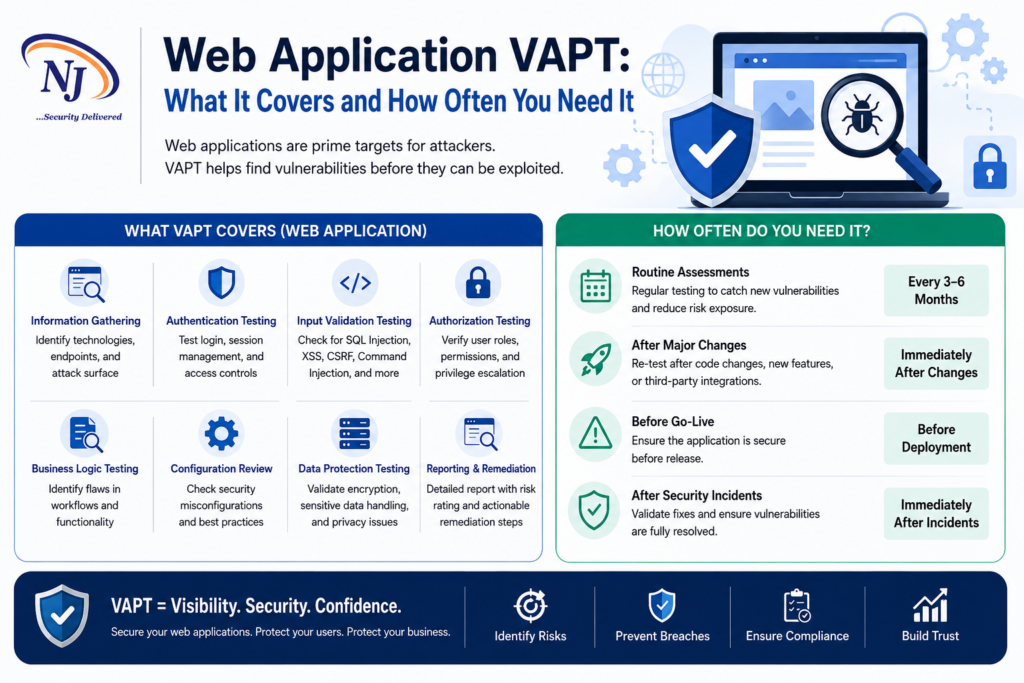
Your website might be the first thing a customer sees, but it’s also the first thing an attacker probes. Login forms, payment gateways, file uploads, search bars, and APIs all sit on the open internet, reachable by anyone, at any hour. A single overlooked flaw in any one of them can expose customer data, drain accounts, or hand an attacker a foothold into your entire network. We’ve run web application VAPT engagements for clients who were confident their site was clean, simply because it had “never had a problem.” Confidence isn’t evidence. In our experience, most applications that haven’t been formally tested in over a year turn up at least one medium-or-higher severity finding, often in a feature nobody thought to question because it had been working fine for years. This guide walks through what web application VAPT actually covers, how it’s carried out, and — the question we get asked most often by clients — how frequently you genuinely need it. What is Web Application VAPT? Web Application VAPT (Vulnerability Assessment and Penetration Testing) is a focused security exercise that examines your website, web portal, or web-based application for exploitable weaknesses. It combines two complementary techniques: Vulnerability Assessment (VA): Automated and manual scanning of your application to identify known flaws, misconfigurations, and weak points across its code, server setup, and third-party components. Penetration Testing (PT): Certified ethical hackers actively attempt to exploit those flaws, the way a real attacker would, to confirm whether a vulnerability is genuinely dangerous or just theoretical. Unlike a generic network scan, web application VAPT is built around how web apps actually behave: how they handle user input, manage sessions, authenticate users, and talk to back-end databases and APIs. According to NIST SP 800-115, the technical guide most penetration testing methodologies in the US and India are built on, this kind of targeted, application-aware testing consistently surfaces risks that generic infrastructure scans miss entirely. Why Web Applications Are a Prime Target Web applications are attractive targets for a simple reason: they’re always reachable, and they usually sit closest to your most valuable data. A flaw in your login page or checkout flow doesn’t just affect that one feature — it can expose your customer database, payment information, or internal systems sitting behind it. Most breaches involving web applications trace back to a small, recurring set of issues: unvalidated user input, weak authentication, outdated libraries, and misconfigured servers. None of these require a sophisticated attacker. They require an unpatched application and enough time, and on the open internet, time is the one thing attackers have plenty of. What Web Application VAPT Covers A thorough web application VAPT engagement looks across the entire application, not just the obvious entry points. Here’s what’s typically in scope: OWASP Top 10 Vulnerabilities The OWASP Top 10 is the industry-recognized baseline for web application risk, maintained by the Open Worldwide Application Security Project. Our testing covers it in full, including: Broken Access Control — can a regular user view or modify another user’s data simply by changing a URL or parameter? Injection flaws — SQL injection, command injection, and similar attacks where unvalidated input reaches a backend system Cryptographic failures — sensitive data transmitted or stored without proper encryption Security misconfiguration — default credentials, verbose error messages, exposed admin panels Cross-Site Scripting (XSS) — attacker-controlled scripts running in another user’s browser Vulnerable and outdated components — libraries, plugins, or frameworks with known CVEs Identification and authentication failures — weak password policies, broken session management, missing multi-factor authentication Server-Side Request Forgery (SSRF) and other emerging risk categories Authentication and Session Management We test login flows, password reset mechanisms, session timeout behavior, and token handling to confirm an attacker can’t hijack, guess, or bypass a legitimate user’s session. Business Logic Flaws Automated scanners are good at finding technical bugs, but they routinely miss logic flaws specific to how your application actually works — manipulating a price field during checkout, replaying a discount code beyond its intended limit, or skipping a verification step by calling an API endpoint directly instead of going through the UI. This is where manual testing by an experienced human tester earns its value; a scanner doesn’t know your business rules, but a tester who’s read your spec does. File Upload and Input Handling Any feature that accepts files or free-text input — profile pictures, document uploads, comment boxes, search fields — is tested for malicious file uploads, injection attacks, and improper sanitization. API Endpoints Behind the Application Most modern web apps run on REST or GraphQL APIs behind the scenes. We test these endpoints directly for broken object-level authorization, excessive data exposure, and rate-limiting gaps, not just the visible front end a user actually sees. Server and Configuration Review Beyond the application code itself, we review the underlying web server, SSL/TLS configuration, HTTP security headers, and exposed directories or files that shouldn’t be publicly accessible. Black Box, Grey Box, and White Box Testing: Which One Do You Need? Not every engagement needs the same level of access. We scope this with you up front, based on what you’re trying to learn: ApproachTester AccessBest ForBlack BoxNo prior knowledge or credentialsSimulating an outside attacker with zero insider informationGrey BoxLimited access, such as a standard user accountMost real-world engagements; balances realism with depthWhite BoxFull access, including source codeDeepest possible coverage, often paired with source code review Most of our clients get the best value from grey box testing. It mirrors what a registered user — or a compromised user account — could actually do, while still letting testers dig deeper than a complete outsider could. Pure black box testing looks more “realistic” on paper, but it often burns scoped hours on reconnaissance an attacker has unlimited time for and you don’t. Our Web Application VAPT Methodology We follow a structured approach aligned with the OWASP Testing Guide, PTES (Penetration Testing Execution Standard), and NIST SP 800-115: Scoping: Confirm which domains, subdomains, and environments (staging or production) are in scope, along with
VAPT Services: Protect Your Business in 2026 and Beyond
Cyberattacks are no longer a distant threat reserved for large corporations. Small businesses, healthcare providers, fintech startups, and government agencies are all in the crosshairs of increasingly sophisticated hackers. According to IBM’s 2025 Cost of a Data Breach Report, the average breach now costs organizations over $4.8 million, a number that has grown year over year. So how do you know if your systems can actually withstand an attack? That’s exactly where Vulnerability Assessment and Penetration Testing (VAPT) comes in. This guide breaks down everything you need to know: what VAPT is, how it works, who needs it, and why choosing the right VAPT cyber security service company can be the difference between resilience and catastrophe. What is VAPT (Vulnerability Assessment and Penetration Testing)? VAPT stands for Vulnerability Assessment and Penetration Testing. It is a two-part cybersecurity process designed to identify weaknesses in your IT systems and then simulate real-world attacks to understand how those weaknesses could actually be exploited. Vulnerability Assessment (VA): Systematically scans your infrastructure including applications, networks, cloud environments, and APIs to discover security flaws. It tells you what is wrong. Penetration Testing (PT): Goes a step further. Certified ethical hackers actively attempt to exploit those vulnerabilities, just like a real attacker would. It tells you what can actually be broken into and what the damage would look like. Together, VA and PT give you a complete, honest picture of your security posture. Not just a checklist but a real-world test of your defenses. Think of VA as your annual health check-up, and PT as a stress test that tells you how your body responds under real pressure. You need both. Vulnerability Assessment vs Penetration Testing: Key Differences Many organizations confuse the two, or use the terms interchangeably. They are related, but they serve different purposes. Here is a side-by-side breakdown: Aspect Vulnerability Assessment Penetration Testing Goal Find all vulnerabilities Exploit specific vulnerabilities Approach Broad, automated scanning Manual, targeted attack simulation Depth Wide coverage Deep, focused testing Output List of vulnerabilities + severity Proof-of-concept exploits + impact Frequency Continuous or quarterly Annual or post-major changes Best For Routine risk visibility Validating security posture The real power comes when you combine both. VA gives you broad coverage; PT gives you depth. A mature security program needs both running in tandem, which is exactly what a quality VAPT service delivers. Types of VAPT Services: What We Test Not all systems carry the same risks. Nishaj Infosolutions offers specialized VAPT services across every layer of your digital environment: 1) Network VAPT Services Your network is the backbone of everything. Network VAPT Services examine firewalls, routers, switches, VPNs, and internal network segments for misconfigurations, open ports, unpatched vulnerabilities, and lateral movement risks. Whether you run an on-premise data center or a hybrid network, we test it end to end. 2) Web Application VAPT Web apps are one of the most commonly targeted attack surfaces. We test for OWASP Top 10 vulnerabilities including SQL injection, cross-site scripting (XSS), broken authentication, and insecure direct object references. If your customers interact with it, we secure it. 3) Mobile Application VAPT Android and iOS apps introduce unique attack vectors such as insecure data storage, improper session handling, and reverse engineering risks. Our mobile VAPT covers both client-side and server-side components of your mobile ecosystem. Cloud Security Assessment Migrating to the cloud does not mean you inherit security. Misconfigured S3 buckets, overprivileged IAM roles, and exposed APIs have caused some of the biggest breaches in history. We assess AWS, Azure, and GCP environments against cloud security best practices and CIS benchmarks. API Security Testing APIs are the connective tissue of modern software and one of the most overlooked attack surfaces. We test REST, SOAP, and GraphQL APIs for authentication flaws, rate limiting issues, data exposure, and injection vulnerabilities. Source Code Review Security should be built into development, not added after the fact. Our static and dynamic code review catches security bugs early, before they reach production. VAPT Methodology: Our Step-by-Step Approach A good VAPT is not a one-size-fits-all scan. At Nishaj Infosolutions, we follow a structured, risk-based methodology aligned with industry standards including OWASP, PTES (Penetration Testing Execution Standard), and NIST SP 800-115. Step 1: Scoping and Requirement Gathering We begin by understanding your business including which systems are in scope, what data is sensitive, what compliance requirements you are working toward, and what your risk tolerance looks like. Clear scope means no surprises. Step 2: Reconnaissance and Information Gathering Before we test anything, we gather intelligence including publicly available information, DNS records, WHOIS data, exposed subdomains, and technology fingerprints. This is exactly what a real attacker does before striking. Step 3: Vulnerability Identification Using a combination of automated scanning tools (Nessus, Burp Suite, Nmap, OpenVAS) and manual expert analysis, we identify vulnerabilities across your systems. Automation finds the obvious; manual testing finds what automation misses. Step 4: Exploitation (Penetration Testing) With your explicit authorization, our ethical hackers attempt to exploit identified vulnerabilities. We do not just prove a vulnerability exists. We demonstrate real-world impact: Can we escalate privileges? Can we access sensitive data? Can we move laterally through your network? Step 5: Post-Exploitation Analysis We assess what an attacker could do after initial access, including data exfiltration pathways, persistence mechanisms, and potential business impact. This step is what separates a real VAPT from a basic scan. Step 6: Reporting Every finding is documented with a clear severity rating (Critical, High, Medium, Low), proof-of-concept evidence, business impact explanation, and actionable remediation steps. We produce two versions: an executive summary for leadership and a technical report for your security team. Step 7: Remediation Support and Re-Testing We do not disappear after handing over a report. Our team provides remediation guidance, answers your team’s questions, and offers re-testing to verify that fixes have been implemented correctly. Who Needs VAPT (Vulnerability Assessment and Penetration Testing) Services in 2026? The short answer: any organization that stores, processes, or transmits sensitive data. But let